
The thought of providing good dental care to an unwilling dog or cat can seem impossible, but with the right tools it is entirely within reach. Toothbrushes, toothpaste in pet-friendly flavors, wipes, chews, sprays, powders, water additives, and dental foods are all available, and all can make a real difference in how often your pet needs a professional cleaning. Which products are best depend on your pet and your lifestyle. Toothbrushing every day is the ideal routine, but when that habit doesn’t stick the other options can pick up the slack.
Flora Family Vet in Kissimmee sees pets with dental disease every day, and the ones whose families are able to provide home dental care usually need far fewer professional cleanings. When a cleaning is needed, our AAHA-accredited hospital provides gold-standard dental care for dogs and cats, with full-mouth digital X-rays to show what is happening beneath the gums and cleanings under anesthesia to treat the disease we find. Our team would love to help you build a home dental routine your pet will actually put up with. If your pet's breath has turned foul or they have started chewing on one side, we keep same-day urgent care appointments open, so call ahead and we will fit them in. To start building a routine that suits your pet, get in touch with us.
What Makes a Home Dental Routine Actually Work
- Brushing is the one tool that scrubs plaque off the gumline, and daily or every-other-day sessions beat a weekly catch-up.
- Combinations beat any single product: mechanical tools break up the bacterial film, chemical products work on what's left.
- Wipes, dental diets, and chews are real options for the pet who refuses a brush, though nothing used at home removes hardened tartar.
- Home care sets how often cleanings are needed, but it can't reach disease below the gumline.
What's Happening in Your Pet's Mouth Between Cleanings?
Between cleanings, plaque coats a clean tooth within hours, and two to three days is all that film needs to start mineralizing into tartar. Once the inflammation it causes slips beneath the gumline, you are looking at periodontal disease, which eats away the bone and ligament anchoring each tooth. The early stage is gingivitis: gum margins turn red and swollen and bleed at a light touch, and it can still be turned around. Deeper in the pocket between tooth and bone, the attachment erodes for good, which separates a mouth that needs cleaning from one that needs extractions. A raw gumline also opens a route into the bloodstream, and long-running oral infection has been tied to extra strain on the heart, kidneys, and liver.
Home care won't hold plaque at zero, but it slows the march from soft film to hardened deposit enough to change the timeline. A look inside the mouth is part of our wellness exams, and that's usually where we spot buildup creeping along the back molars before anyone at home smells a thing.
How Often Do You Really Have to Brush?
Daily brushing is the target, and every other day is the floor that still works. Where families slip is brushing frequency: teeth cleaned every second day carried visibly less buildup after months, while a once-a-week pass changed nothing. A weekend-only session is not a smaller version of the daily habit. Deposits rebuild and mineralize faster than one weekly pass can match.
Reach for a pet paste, not your own tube. Xylitol in human formulas can crash a dog's blood sugar, and the fluoride and foaming agents in them are not meant to be swallowed. Poultry, malt, and seafood flavors exist because taste does most of the persuading.
Why Most Pets Refuse the Brush at First
Most pets refuse the brush at first because of how it was introduced, not because of who they are. Over a few weeks of daily handling, most settle rather than sour, and measured stress falls. Week one is not about clean teeth. It is about a pet who stays in the room when the brush comes out.
| Step | How it goes | Move on when |
| Hands only | Cup the muzzle, peel back a lip for two seconds, pay up with a treat | Your pet steps toward you instead of away |
| Flavor | Offer the paste on a fingertip and let them work it off | They come hunting for the tube |
| Fingertip | Run a bare finger or gauze over the outside of the teeth briefly | Nothing gets turned away or batted at |
| Bristles | A soft brush or finger brush on the canines and molars | The whole session stays relaxed |
| Everything | Roughly 30 seconds a side, outer surfaces only | You have reached maintenance |
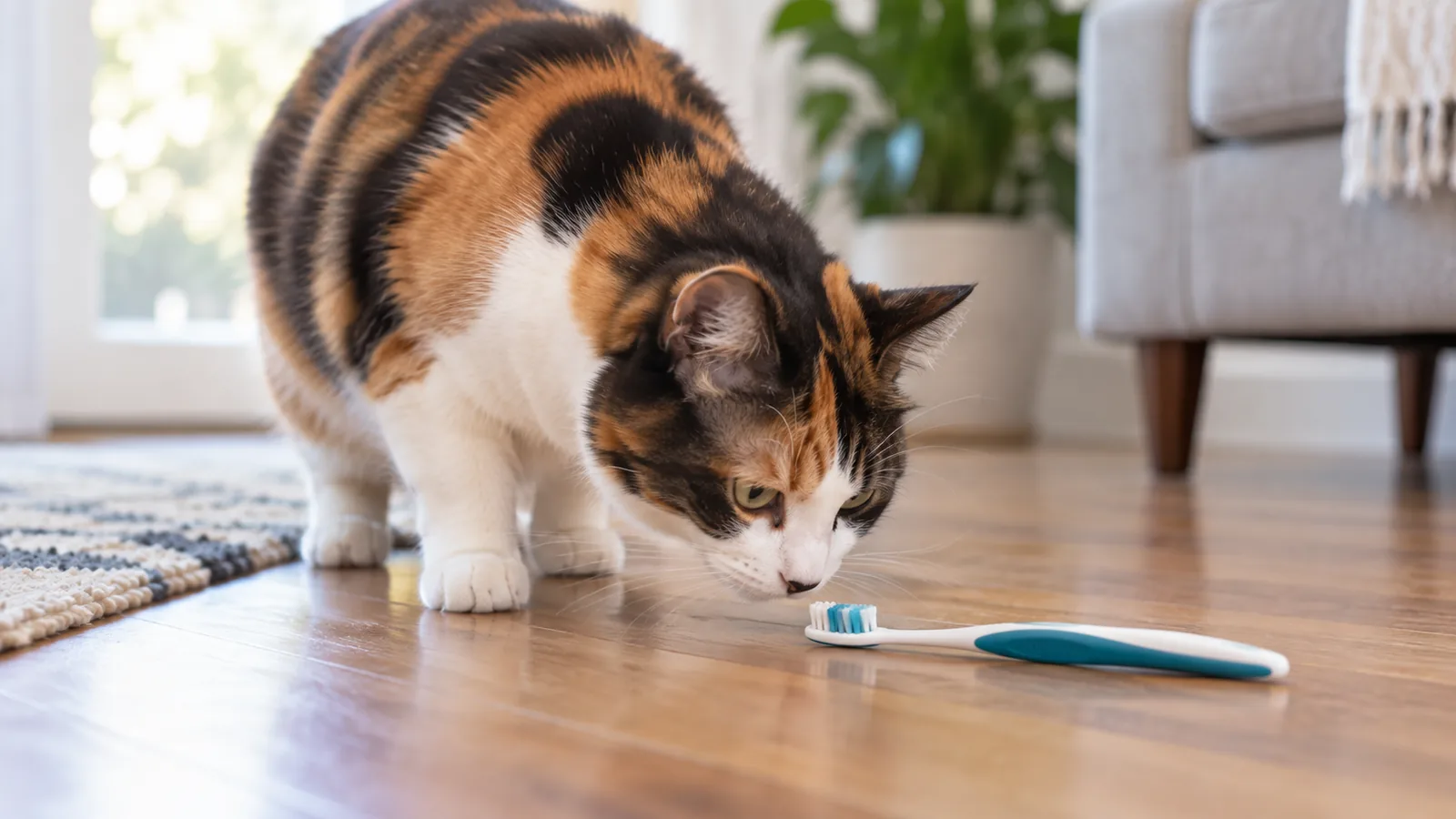
Dogs and cats need different handling. Brushing a dog's teeth goes better when you lift the lip instead of prying the jaw apart, tip the bristles toward the gumline at roughly 45 degrees, and stay on the outer surfaces where plaque gathers. Brushing a cat's teeth wants a finger brush or an ultra-soft small-headed brush, an approach from the side of the face, and sessions counted in seconds. Puppies and kittens take to it fastest, since a mouth that has never hurt expects nothing bad. The setbacks are predictable: sessions that run long too soon, a flavor your pet dislikes, pressure that leaves gums tender, and pushing through a struggle instead of dropping back two steps. Book a brushing demonstration and we will practice with you holding the brush.
What If Your Cat Won't Tolerate a Brush?
If your cat won't take a brush, a daily wipe is the next best mechanical option. Used daily, brushing alternatives such as a dental wipe, a gauze square, or a textured finger glove land just behind bristles on plaque and gum health, though no home tool budges tartar that has already set. Reach is the catch: a wipe cleans flat outer surfaces, slides over the gumline rather than under it, and rarely reaches the back teeth where trouble starts. For the cat who tolerates three seconds of handling, three seconds of wiping every night still beats a perfect brushing that happens twice a year.
Wipes and gauze aren't enough when there's red or receding gum, a broken tooth, or breath strong enough to notice from across the room. Rubbing inflamed tissue hurts and teaches your cat that mouth handling means pain. Those mouths need an exam first, and our veterinarians can tell you which tool is realistic for your pet.
Where Do Gels, Sprays, and Water Additives Fit?
Gels, sprays, and water additives fit alongside something mechanical, rarely on their own. Water additives used by themselves, with nothing brushed or chewed, left deposits essentially unchanged, while the same additive beside even light mechanical care outperformed that care alone. Breaking up the biofilm is what lets an antimicrobial reach gum tissue. The exception comes after a professional cleaning: with the barrier already scaled away, daily use from that day forward dropped plaque, tartar, and bleeding gums well below what no aftercare produced.
Gels and enzymatic pastes go on directly and stay put, sprays reach the gumline with no brush involved, and powders and additives work through the food or water bowl. Look for chlorhexidine, zinc salts, delmopinol, or an enzyme system, check the label for xylitol, then pair whichever one you pick with brushing, a wipe, or a chew rather than asking it to carry the routine solo.
Additives change how water tastes, and some pets answer by drinking less, which is its own problem through a Florida summer. Start at a fraction of the labeled dose, build up across a week, and keep a second bowl of plain water available. Check with us first if your pet has bladder or kidney disease so we can make sure the product you chose won’t make things worse.
Can Food and Chews Do the Work Instead?
Food and chews carry more weight than most families expect, though neither replaces a brush. Both work by force: a large kibble the tooth sinks into, or a chew worked over for ten solid minutes, breaks up plaque while it is still soft. Neither one cleans along the gumline the way bristles do.
Dental diets work two ways at once, with tartar-control ingredients that block mineralization and a fiber weave that holds its shape while the tooth presses in. Cats fed a dental kibble built to give way slowly instead of crumbling showed less gingivitis and less tartar than cats on standard food, which makes diet a real answer for a cat who will never sit still for bristles, and for dogs whose breed, age, or treatment history raises their risk. Daily dental chews cut both plaque and gum inflammation against a no-chew control. The caveat: "dental" on a package is a marketing word, not a test result, so the specific product matters far more than the category.
Which Chews Are Safe?
A safe chew bends, flexes, or breaks down under pressure. These checks sort the safe from the dangerous:
- Press it with a thumbnail: Leave no dent behind and the chew is hard enough to crack a tooth.
- The repeat offenders: Antlers, bones cooked or raw, hooves, and rigid nylon top the list of chews hard enough to fracture teeth, and the large upper fourth premolar takes most of the damage. Add ice cubes, plus tennis ball fuzz that sands enamel away.
- Size and supervision: Match the chew to your pet's size and chewing style, stay in the room, and take it away once it's small enough to swallow whole.
- Signs of a fractured tooth: Chewing on one side, dropping kibble, pawing at the face, or a pink, purple, or dark spot on a tooth all call for an exam. We keep urgent care openings during our hours so a fractured tooth can get pain control and a plan to prevent infection.
Which Dental Products Have Actually Been Tested?
The dental products with real evidence behind them carry an outside seal, not a claim written by the company printing the box. VOHC-accepted products earn that seal by meeting a set standard for reducing plaque or tartar under test conditions. The roster runs from diets and treats to chews, wipes, gels, additives, and toothpastes, and it is free to check on your phone in the pet food aisle. Any label promising to scrub a tartar-caked tooth back to white is selling you a photograph, since nothing applied at home dissolves mineralized deposits.
| What you use | What it actually does | When to reach for it |
| Toothbrush | Lifts more plaque than any other home tool | Every day, or every second day at the very least |
| Wipes, gauze, textured gloves | Nearly a brush on outer surfaces, weak at the gum margin | The pet who will not open up for bristles |
| Dental diet | Genuine drops in tartar and inflamed gums | Cats above all, and dogs already at risk |
| Dental chews | Measured reductions in plaque and gingivitis | One a day, matched to size and chewing style |
| Gels, sprays, powders | Chemistry only, with no scrubbing action | Paired with a brush or a wipe, never solo |
| Water additives | Thin results alone, solid ones beside mechanical care | A backstop for the whole household |
| Professional cleaning | The only way tartar and under-gum disease come off | On whatever schedule your pet's mouth demands |
What Can a Cleaning Do That Home Care Can't?
A cleaning reaches what home care cannot. A brush, a wipe, and an additive all work on the crown above the gumline and stop there, hardened tartar stays put, and most periodontal disease hides in the pocket under the gum.
Anesthesia buys access. With your pet asleep, each tooth gets probed for pockets, scaled above and below the gumline, and polished, while full-mouth X-rays reveal root infection and bone loss invisible from above. Roughly two-thirds of every tooth sits below the gumline, so skipping imaging means grading a mouth on only the part you can see. Professional dental cleanings are also when a tooth that can't be saved comes out. Anesthesia-free dental cleanings take the visible tartar off the crown and leave everything beneath the gumline exactly as it was, and the mouth looks tidier while the bone underneath keeps disappearing.
No standard schedule fits every pet. Small breeds, flat-faced dogs with crowded teeth, cats with a history of resorptive lesions, and pets with previous periodontal treatment tend to come back sooner, while a large dog with a solid routine at home may stretch much longer. The mouth sets the interval.
How Do You Keep a Dental Routine From Falling Apart?
A routine survives when it's short, layered, and forgiving. Sixty seconds most evenings does more than a ten-minute production once a month, and a pet who is allowed to stop and comes back more willing the next day is the whole premise of cooperative care. A few habits carry the rest:
- Tie it to a fixed habit: Brush right after the last treat of the night, or while the coffee maker gets loaded.
- Stack it early: Brush, chew, and additive together hold up. A brush by itself has no backup.
- Split the duty: Two people who both know the routine cover a work trip, a late shift, or a rough week.
You'll know it's working when gum edges stop bleeding, breath turns neutral instead of sour, and lifting a lip stops being a negotiation. Drooling, dropping food, pawing at the face, swelling under one eye, or bleeding with no brushing involved all mean something hurts, so give us a call when you notice them, since more brushing won't fix a tooth that's already broken.
What Families Ask Us About Home Dental Care
What about the baking soda and coconut oil people swear by?
Baking soda and coconut oil both fall short of a pet toothpaste. Baking soda scratches, tastes bad enough to end the session early, and brings a salt load that suits no pet with heart or kidney disease. Coconut oil is safe and popular and does nothing to plaque, which makes it a bribe rather than a cleaner. It’s also calorie heavy and causes diarrhea in many pets. Pet toothpaste is the best way to go.
My dog is eight and already has tartar. Is it too late to start?
Starting late still pays off. Bristles won't dissolve what's already mineralized, so the order matters: a cleaning to reset the mouth, then home care to protect the result. Working on a sore mouth also teaches your dog that handling hurts, which makes every session afterward harder. Let us look first, treat what needs treating, and begin the routine on a comfortable mouth.
My cat still eats normally. Doesn't that mean their mouth is fine?
A normal appetite doesn't mean a healthy mouth. Cats hide oral pain well, and many keep eating straight through advanced periodontal disease or painful resorptive lesions because hunger outranks discomfort. The subtle signs are the useful ones: chewing on one side, dropping kibble, swallowing pieces whole, grooming less, or a sudden preference for canned food.
Your Next Move on Your Pet's Teeth
Nothing in a bottle or a bag holds a dental routine together alone. Layering is what the evidence supports: something mechanical most days, something chemical beside it, and a professional cleaning when the mouth needs a real reset. If brushing has gone badly at your house, there is almost always a version your pet will accept once we figure out what works for them. Schedule a dental exam at Flora Family Vet in Kissimmee and we will start from where your pet's mouth stands today.
Reviewed by Dr. Lima